The 8-Circuit Model of Consciousness is a framework that breaks the human mind into eight different “circuits” or intelligences—each responsible for a different layer of how we experience reality.
Instead of seeing your mind as one thing, this model shows that you have multiple systems operating at once, including:
- Survival & safety (body, attachment, nervous system)
- Emotions & power dynamics (relationships, boundaries)
- Thinking & meaning-making (logic, interpretation, beliefs)
- Social identity & culture (belonging, morality, roles)
- Pleasure, flow & awe states
- Neuroplasticity & intentional change
- Archetypal, ancestral & “spiritual” experiences
- Non-dual or unity consciousness
Each of these circuits has its own:
- patterns
- triggers
- needs
- and pathways to healing
Why this matters for healing
Most healing approaches treat everything as the same category:
“trauma,”
“anxiety,”
“depression,”
“mindset.”
But in reality, those labels often mix together completely different layers of experience.
For example:
- A body-based safety issue (nervous system dysregulation) won’t resolve through mindset work
- A relational or attachment wound won’t resolve through meditation alone
- A psychedelic or spiritual experience can’t be fully understood through traditional psychology frameworks
This is why people often feel stuck.
👉 You might be doing good work—but at the wrong layer
What the “8-Circuit Ascension Workbook” is about
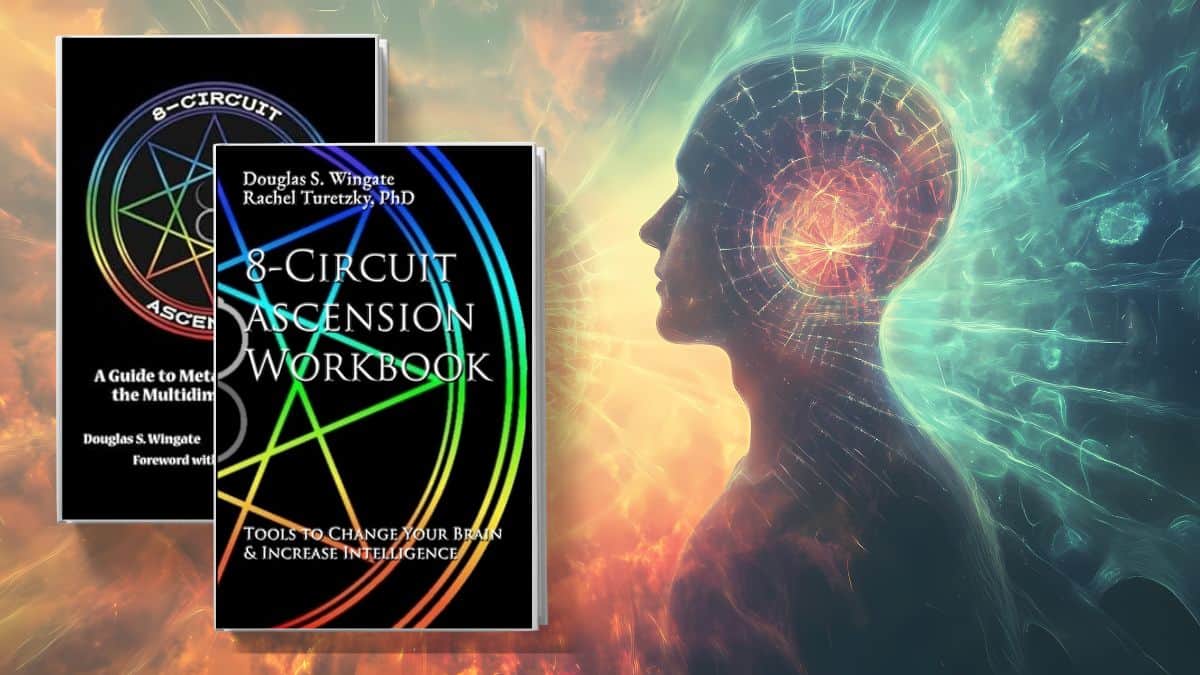
8-Circuit Ascension Workbook: Tools to Change Your Brain & Increase Intelligence by Dr. Doug Wingate is designed to solve this exact problem.
Instead of just explaining the theory, the workbook gives you practical tools to work with each layer of your mind directly.
Inside, you’ll find:
- Reflection prompts to help you identify your patterns and “imprints”
- Exercises and practices for each circuit (from body-based to transpersonal)
- Guided meditations to help shift how your nervous system responds
- A framework for understanding your personal “reality tunnel”—the filter through which you experience life
The goal isn’t just awareness. It’s learning how to:
- recognize which part of you is active
- understand what it needs
- and actually change how your system responds
What is a “reality tunnel”? (and why it matters)
One of the most useful ideas in the book is the concept of a reality tunnel.
A reality tunnel is the lens your brain uses to interpret the world—shaped by:
- early life experiences
- attachment patterns
- trauma
- culture and belief systems
In other words:
You’re not seeing reality directly. You’re seeing it through a filter.
And most of the time, that filter is unconscious.
Healing, in this model, isn’t just about “fixing symptoms.”
It’s about:
- becoming aware of the filter
- and learning how to change it (what the book calls “metaprogramming”)
Why this model is especially helpful for psychedelic integration
If you’ve had a psychedelic experience (or are considering one), this model is especially useful.
Because not all experiences are the same.
You might encounter:
- early life material (safety, attachment)
- emotional or relational themes
- symbolic or archetypal imagery
- ancestral or transpersonal experiences
- states of unity or ego dissolution
Without a framework, these can feel:
- confusing
- overwhelming
- or hard to integrate into daily life
The 8-circuit model helps you:
- understand what kind of experience you had
- and how to work with it afterward in a grounded way
How to know which “circuit” you tend to operate from
Most people have a default way of processing reality.
Some people are:
- very body-based and focused on safety
- highly emotional or relational
- analytical and logic-driven
- oriented toward meaning, spirituality, or expanded states
The challenge is:
👉 We tend to overuse what we’re good at
👉 And underdevelop other parts of our system
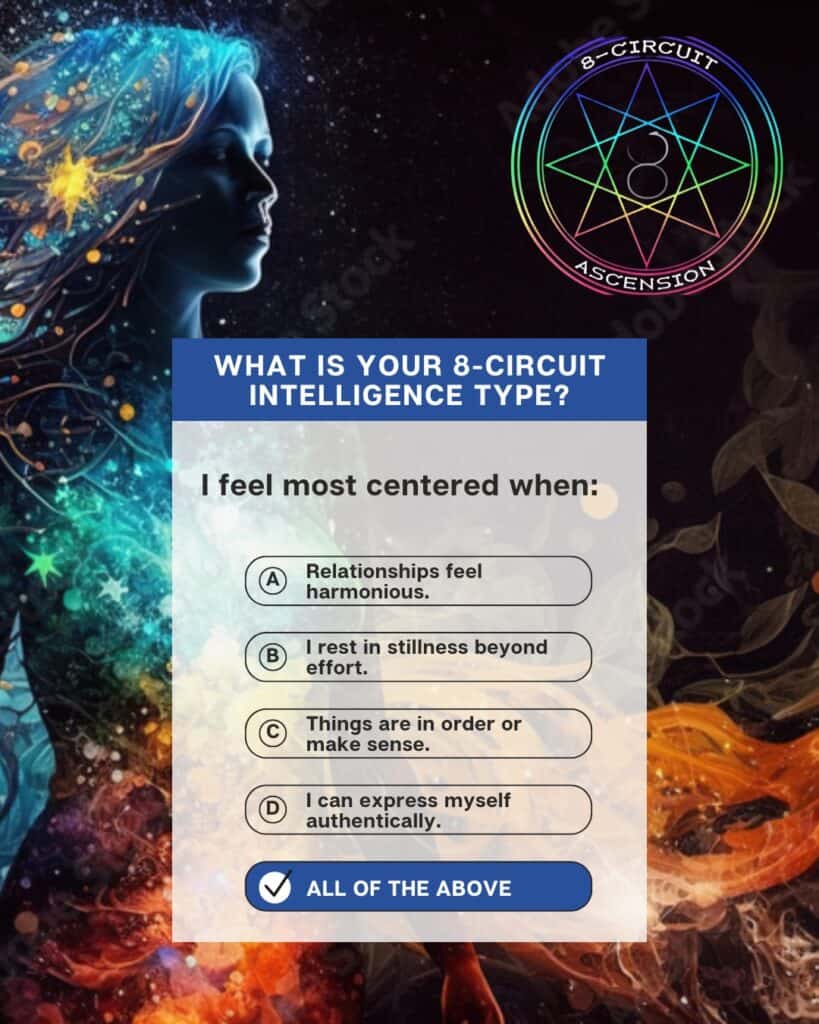
Take the quiz: understand how your mind is wired
If you want to explore this for yourself:
It will help you identify:
- your primary intelligence pattern (your default lens)
- your secondary tendencies
- and your integration edges—where growth and healing are most likely to happen
You’ll start to see:
- why certain tools have worked for you (and others haven’t)
- how you respond under stress
- and what kind of support actually makes sense for you
A more precise way to approach healing
The biggest shift this model offers is simple:
You stop asking “What’s wrong with me?” and start asking “What part of me is active right now?”
From there, everything becomes more precise.
More targeted.
More effective.
And often—much faster.
Explore the workbook
If you want to go deeper:
8-Circuit Ascension Workbook: Tools to Change Your Brain & Increase Intelligence is now available.
It’s one of the most practical frameworks we’ve seen for:
- understanding your mind
- working with complex healing processes
- and integrating both psychological and psychedelic experiences